
Preventive measures to avoid engine damage
Many engine failures start small but end up big. A few seconds of rattling on start-up, a ticking noise that sometimes disappears, or slightly lower oil pressure than normal may seem harmless, but they can be the starting point of serious consequential damage. And with components such as the timing chain or bearing shells, “driving a bit longer” can sometimes be exactly what makes the difference between a relatively straightforward repair and a complete engine overhaul.
That’s why prevention is not a luxury. With the right oil, shorter service intervals, and targeted checks (such as an endoscopic inspection, bearing inspection, and timing chain inspection), many problems can be detected early. This not only saves costs, but also reduces downtime and prevents unexpected breakdowns.
Below you’ll find practical measures you can apply right away, along with a clear explanation of which checks make the most sense for your situation.
What measures can I take?
BMW uses many different engines, each with its own points of attention. In some engines, the timing chain is a weak spot; in others, issues tend to develop around the main bearings or connecting rod bearings.
A good rule of thumb is to change the oil regularly, preferably every 5,000–10,000 km. This keeps the engine properly lubricated and often helps prevent wear and consequential damage.
A preventive endoscopic inspection of the cylinders is also possible. If scratches on the cylinder walls or heavy deposits/carbon buildup on the pistons are found, it can often be repaired in time before it develops into a larger problem.
Checking the main bearings and connecting rod bearings is also essential. These bearings sit directly on the crankshaft and are crucial for smooth engine operation. They use bearing shells made of relatively soft material (such as copper or zinc alloys). These are wear parts: they “sacrifice” themselves to protect the more important components.
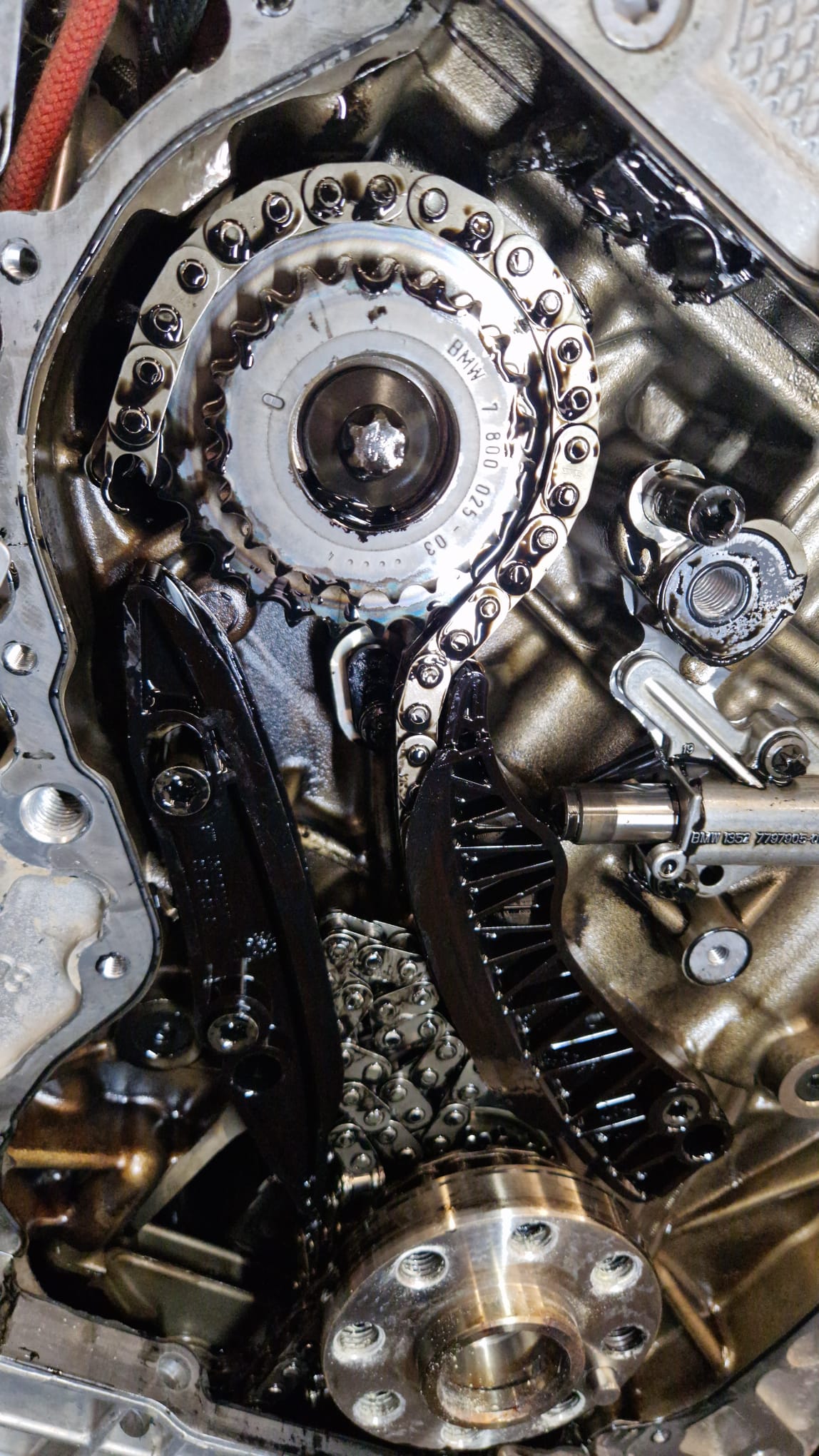
The timing chain also deserves attention—ideally before you hear any ticking or rattling. The timing chain connects the crankshaft to the camshaft and, on many engines, also drives the oil pump. If the chain slips or breaks, the consequences can be very severe.
As you can see, there are various preventive measures to protect the engine and extend its service life. Do you have questions or would you like advice? Feel free to call us or send a message via WhatsApp. You can also use the enquiry form. The team at Motorschmiede GmbH will be happy to help.
At the first signs, you should act and have the engine checked to prevent costly consequential damage.
Are there any other preventive measures?
Yes. It’s important to keep the intake and exhaust passages and the related components clean. In practice, we often see deposits and carbon buildup on parts such as the EGR cooler, turbocharger, intake passages, exhaust passages, intake manifold, and the diesel particulate filter (DPF).
Although these are “peripheral components,” severe blockages or heavy carbon buildup can cause significant damage. In addition to power loss and increased fuel or oil consumption, there is also a risk (rare, but possible) that parts break off and enter the combustion chamber.
Cleaning is usually quick to carry out and often has an immediate, noticeable effect. If your car is already at a workshop, feel free to have these components checked as well.
Do you offer a bearing service?
Yes, we do. If you’d like to learn more about our bearing service, please take a look at this page:
Learn more >>>
Do you offer a timing chain service?
Of course. If you’d like to learn more about replacing the timing chain, please take a look at this page:
Learn more >>>
Is engine oil really that important?
Yes! Lubrication is one of the most important factors for a healthy engine. Even if all components are technically fine, nothing can run smoothly without the right amount and the right type of oil. Oil prevents metal-to-metal contact and protects all rotating and sliding parts.
That’s why you should always use the correct oil according to the manufacturer’s specifications. Cheap or incorrect oil can cause more harm than good in the long run. Every engine is designed for specific additives and oil properties.
Our advice: always use oil that meets the factory specification so your engine lasts as long as possible.
What is the worst that can happen?
Severe engine damage where the engine block is damaged beyond repair. An engine essentially consists of two main parts: the engine block and the cylinder head. The engine block houses, among other things, the crankshaft, main and connecting rod bearings, and the oil pump. The cylinder head contains the camshaft (with the valvetrain) as well as the intake and exhaust valves. The connection between the engine block and the cylinder head is made, among other things, via the timing chain, which controls the timing of the entire system.
What if my engine is damaged beyond repair?
In that case, the only option is usually a replacement engine. This can be a rebuilt engine (where—apart from the engine block and cylinder head—almost all components have been replaced), or a used engine that has been checked and partially repaired (damaged parts are replaced). Another option is a completely new factory engine.
If you choose this solution, you can also purchase a replacement engine from us. In our shop you’ll find a wide selection of rebuilt engines.
Get in touch now!
Which noises can indicate an engine problem?
There are various noises that can point to (early) engine damage, such as rattling, ticking/clattering, and knocking. Each type of noise often has a typical cause.
Do you hear a rattling noise coming from the engine?
A rattling noise may indicate an issue with the timing chain. If the chain has stretched, it no longer sits tightly against the guide rail. This is often clearly noticeable during a cold start in the morning, because the chain tensioner needs a moment to build up pressure—and the noise may disappear afterwards.
Do you hear ticking or clattering from the engine?
With ticking/clattering, there is a good chance that a guide rail is loose or even broken. As soon as the chain tensioner puts tension on the rail again, the noise may (temporarily) reduce or disappear.
Do you hear a knocking noise from the engine?
A knocking noise at idle or while driving can indicate bearing damage. Due to wear, too much play can develop in the bearing shells. Damaged main bearings or connecting rod bearings are also possible. In some cases, damage to the crankshaft can be the cause as well.
What are the consequences if you don’t address these problems?
If timing chain issues are ignored, this can eventually lead to the chain slipping—or even breaking. At that point, the engine can no longer operate properly and repair (engine rebuild/engine repair) becomes necessary. The same applies to broken guide rails: small plastic fragments can break off, reach the oil pump and clog it. This can cause a loss of oil pressure and lead to serious damage to other components.
If you suspect a bearing problem, acting quickly is even more important. If you keep driving, you risk the bearings wearing further or even failing completely. In the worst case, the engine block can be damaged beyond repair and a replacement engine may be required.
Solution / repair
To replace the timing chain/guide rails or to carry out a bearing repair, the engine usually needs to be removed. This takes time; the estimated duration is around 3 days.
When replacing the timing chain/guide rails, an optional upgrade can be carried out. In this case, the chain can be fitted with a Tritan coating for additional stability. Guide rails with cavities (factory design) can also be replaced with solid versions.
For bearing repairs, replacing the bearing shells alone is often sufficient. If the connecting rod bearings are damaged, the connecting rod (and the corresponding mating component) can also be replaced. With main bearings, it’s different: if the damaged area is within the engine block and cannot be replaced, then the engine block itself is affected and must be replaced. If only the semi-circular thrust elements (mating pieces) are defective, they can sometimes be replaced separately.
You can find Motorschmiede GmbH here
About us

- Motorschmiede GmbH in Oberhausen has been established for over 10 years.
- Our team of more than 10 employees consists of specialists in BMW and MINI engines.
- Engine rebuilding, engine repair, and the sale of replacement engines are part of our daily work.
- We also carry out smaller repairs, such as replacing valve stem seals, walnut blasting, and more.